Automate what you can. Keep what is human.
I help organisations automate their work with AI, from concept until the system runs. Independent, and based on what I built myself first.
At Multimedi, AI already does this on its own
- AI puts new contacts from the mailbox into the CRM
- AI writes the quote after a sales conversation
- AI answers emails, as drafts
- AI prepares the invoices
- AI drafts the monthly report
- AI keeps track of the website statistics
- AI builds a tailored portal for every employee
- AI scans new public tenders
- AI is helping to build a client portal
With every client, I show live how it runs at my company.
Why does the organisation notice so little of the efficiency gains employees get from AI?
Everyone works with ChatGPT, Copilot or Claude. But personal time savings are not yet organisational value.
To capture that value as an organisation, your organisation has to be ready for it:
- your data structure in order;
- personal agents that you steer and that log their work, using a knowledge graph and Markdown files;
- an agentic system that runs at the level of the organisation, together with smart workflows.
How I work

Direction
Half a day with your leadership team. I show how it runs at my company, with an example on your own data. You leave with a decision document: where to speed up first, what stays human, and who owns it.

Foundation
We map where your information lives and who owns it. For each process we define what the machine takes over and what stays human.

Building together
The first application, built with someone who knows the trade. Your people build along, so the knowledge stays in-house.

Guidance
I stay involved at a fixed rhythm, every two weeks or monthly, with a small team on your side, until it runs on its own.
If a trajectory calls for training, Multimedi’s trainers provide it. That way you have one point of contact.
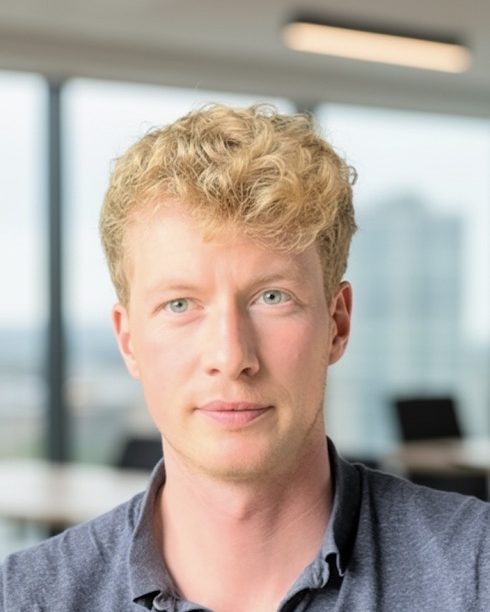
Dominiek Henckaerts
Above all, I am curious. About how technology works, but even more about what it does to people. That is why I delve into philosophy and psychology as gladly as into IT.
I studied economics at KU Leuven and have been an entrepreneur for twelve years. As CEO of Multimedi, which has been training people in new technology for more than twenty years, I see every week how people react when their work changes.
Whatever is new, I try myself first. That is how my team and I rebuilt my own company around AI. The questions this raises, I wrote down in HUMAIN.
Through my experience I speak the language of the CEO, of IT and of the people who do the work every day.
What will be left of my job? Who is responsible when the machine gets it wrong? If everyone has the strongest AI tools, how do I still stand out from my competitors?
In every process we first look for where the human part is, and build around it. Whoever knows what they protect dares to speed up elsewhere.
The book
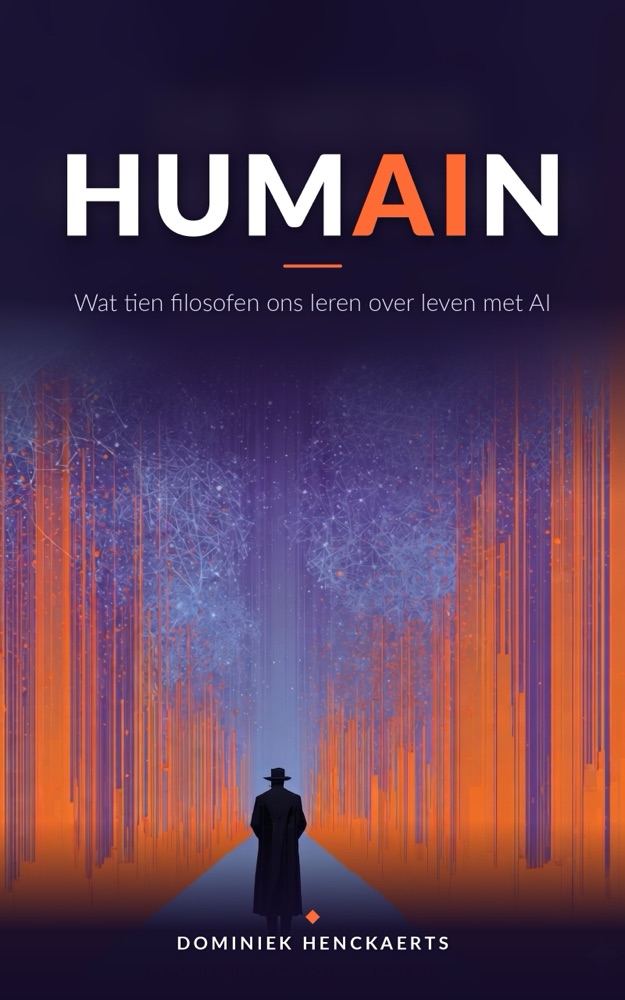
More about the bookHUMAIN
What ten philosophers teach us about living with AI. Ten philosophers, one question: how do we flourish as humans in an age of AI?
- The glass palace
A recommendation does not only take over the choosing, it also takes away the burden of choosing. That very burden is what Dostoevsky’s human wants: being able to choose against the grain proves you are not a mechanism.
- The room without understanding
A machine can produce the form of understanding without the content. Who, then, understands what is being said, and who checks it?
- The banal machine
Thoughtlessness is as destructive as malice. “Computer says no” is a chain of decisions without an owner, while judging remains something a human has to answer for.
- The rock and the meaning
The effort itself is the meaning, not what it yields. What do you do with the effort AI takes off your hands?
What does the human do in your organisation?
Tell me where your organisation stands with AI, and where your people stand. I will tell you whether and how I can help. Preferably over a coffee, online or in person.
I work with a limited number of organisations at a time.
If you would like to follow my thinking: I think out loud about AI and people on LinkedIn, in the series Signaal uit de ruis (in Dutch).